Sign up for our Preferred Customers Club

DVD Your Memories Review

Chris

Posted: 8-26-2010

Check out our great review from Randa over at The Bewitchin’ Kitchen!

She’s offering her readers a chance to win a $25 gift certificate which is good for any of our wonderful media transfer services, so don’t forget to drop in and say hello!

How to Repair A Video Tape, A VHS Repair Guide

Chris

Posted: 8-20-2010

For many families, video tapes often contain some of the most precious memories they have. Since the advent of the camcorder, millions of people worldwide have been filming important events in their and their family’s lives. At some point, many of us have had a tape break, or a VCR eat up their video tape, resulting in a tape that simply won’t play normally anymore. At first glance, you may think all hope is lost, and your tape is gone forever…but it’s actually very easy to repair video tapes yourself! After reading this guide you will have the knowledge to not only repair VHS tapes, but repair video8 tapes, repair betamax tapes, or even repair MiniDV tapes!

Working with large amounts of older media for some time now, I’ve seen nearly every problem a video tape could have. The most common problem is that the tape simple snaps or breaks in the middle somewhere. For this guide, I will be demonstrating the repair of a VHS tape, which is the most common tape repair I see. To perform your own repair, you will need a phillips screwdriver, some splicing tape, scissors, and a steady hand.

VHS Repair Step 1

First inspect the tape, look under the flap, and see if the tape has been damaged. If the tape has split, the evidence will be obvious as there would either be a mess of garbled up tape:

VHS Repair Step 2

or no tape visible under the protective flap:

Once you see that the tape is indeed split, the next step is to open the casing of the VHS up. For this step you will need a standard sized phillips screwdriver. The typical VHS cassette contains 5 screws, one at each corner, and one in the middle.

Once you remove all 5 screws, turn the tape OVER, so the front is facing you, and then gently rock the casing back and forth to lift it up from the base, taking care not to disturb the internal components too much. If you labeled your tape with a sticker, it may need to be cut down the middle in order to separate the two halves of the casing.

The casing should now look like what I have in the image below. Take special note of where the internal components are located, in case anything should get bumped loose or knocked out of place. Taking a digital photo of the opened case, or having a diagram will help you with this.

The next step is to give yourself enough “clean” tape to work with. If the tape has been eaten up or garbled, or mangled, it’s best to simply remove all portion of tape that has been damaged, so you’re left with nothing but clean undamaged tape. Unwind the tape from the reels a little bit to give you about 6 inches on both sides. You may need to gently lift the reel from the cassette in order to pull some of the tape out. Once you have the two ends of tape, take some scissors, and ensure that the tape has been cut with a clean edge. It’s much harder to splice a tape with a frayed or jagged end

Cut a small strip of splicing tape (scotch tape can and will work, just know that it’s much thicker and harder to work with than splicing tape and not advised) Now the trick is to stick both ends of the video tape as flush as possible against the splicing tape, it’s best to splice the underside of the videotape, but not essential.

Now your goal is to remove as much of the excess splicing tape as you can without removing the actual video tape. You can use an x-acto knife if you prefer, but I just use scissors. You’ll need a pretty steady hand to perform this step successfully.

Your video tape should now be all spliced and almost as good as new. Now you need to run the tape through the pinch rollers and wrap it around the top of the cassette. Use the images below as a guide for how the tape runs through.

The last step is to put the casing back together the same way you took it apart. Gently rock the top part of the casing on (You may need to hold the protective flap up as you’re fitting it back on) and then screw it back together.

Voila! You have, hopefully, now just repaired your video tape! Remember, if your tape has been severely damaged, it’s best to bring the repair job to a professional videotape repair guy who has experience with all types of different media, and the best way to go about fixing them.

Wedding Slideshows in San Diego – Custom Video Creation

Chris

Posted: 8-11-2010

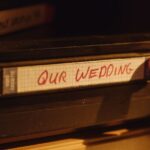
A custom produced slideshow movie can be a great addition to your wedding party. Wedding slideshows are intended to briefly display the lives of both the bride and groom in a touching way. Typically, wedding slide shows are created in three parts. The first part typically displays the images of either the bride or groom, usually starting with baby pictures, and then more images of them progressively older. After both the bride and groom’s images have been displayed, the third part consists of images of both the bride and groom after they have been together, and will usually end with a shot from the wedding party. Many people create slideshows for weddings in order to remind them of their special day and to pass out to the families that attended as well.

Wedding Slideshows San Diego

The first step to creating a slideshow for a wedding is to get ahold of the images you would like to use in the presentation. If the images are not digitized, or scanned, you first must either scan photos yourself, or use a professional photo scanning service in San Diego. Once the images have been digitized, they’re now ready to be inserted into the slideshow creator. There are tons of slideshow creation programs available and most video editing programs come built with an easy slideshow creation tool.

The next crucial step of the wedding slideshow creation process is the music selection. Selecting the right music for the slideshow can really help make it that much better. With wedding slideshows, you generally want to avoid songs with controversial or irrelevant lyrics, such as a “break-up song”, or heavy metal music as it would probably confuse your audience and perhaps give them a headache! Just make sure the music is in good tastes, and choose a song that has significant meaning to the bride and groom.

When creating your first slideshow, it’s easy to get carried away and end up with a slideshow that’s just too long to be practically shown at a party. We’ve found the ideal length for a wedding slideshow to be 2-3 songs or 7-10 minutes long, and each picture should be shown for about 7-10 seconds each. Any longer, and you may start to bore your guests! It’s best to think of the slideshow as a small supplement to the party, not the main attraction.

What Are The Best Blank DVDs to Use For Your Media Transfers?

Chris

Posted: 7-28-2010

Many people are starting to realize that the need to transfer their important family memories onto DVD is rapidly approaching. Many people have already transferred their home movies, but unfortunately, they transferred them onto inferior, poor quality discs. As a result of this, some are losing their family memories MUCH sooner than they would have ever thought! If you are planning to transfer important data to DVD, we recommend doing some quick research about which brand of DVD media would be best to transfer your camcorder videos onto.

It’s been reported that over half of all media you find in the major retail stores are of inferior quality. Simply buying the ‘best’ name brand, or most expensive media on the shelf will not always yield high quality discs. With great care, these inferior discs will maybe last you 10 years before the dye and adhesives start to break down, thus ruining the data and rendering the disc unplayable. Due to this reason, it’s recommended to use archival media that is rated to last decades with proper care. Purchasing poor-quality discs will, in the long run, only lead to lost time and money.
Taiyo-Yuden Spindle

With important data such as home movie transfers or scanned photos, it’s best practice to use an archival-grade media to store them onto, as well as an external hard drive. The discs we use to transfer all the media we receive such as slides to DVD, video to DVD, film to DVD, etc. are rated to last over 100 years! This will allow you more than enough time to guarantee your data’s safety, and an opportunity to keep that data with you for the rest of your life. The brand we recommend is Taiyo-Yuden, which is manufactured out of Japan. We have found these discs give us the least amount of errors and headaches. There are a couple other great brands such as Verbatim +R/-R discs, Sony DVD+R/-R discs, however, these are getting harder to find.

You may have seen some companies promoting the fact that they transfer media onto “Gold Archival DVDs”. There are some facts about the gold DVDs everyone should be aware of. Gold discs have much lower reflectivity than compared to the standard dye DVDs, which causes a lot of disc read and write errors and other compatibility issues to occur. Many of the gold discs we tested had a much lower successful burn rate than compared to the Taiyo-Yuden brand. If you are considering transferring your own media yourself, ensure that the hard work you put into converting everything over to the digital world will not be in vain. Invest the couple extra bucks to get the archival quality media that will ensure you never lose a precious memory again!

How to Convert Audio Cassettes to CD or Mp3 Files – A Quick Guide

Chris

Posted: 7-14-2010

One of the types of requests we see a lot of is people asking to get their audio cassette transferred to CD or MP3s. What many people fail to realize, is that it’s much easier than you think to perform this same type of audio conversion from your own home!

The first step of the process is to get your hands on an audio cassette player. Any audio cassette player/recorder is fine as long as it has either a 3.5mm headphone jack, or those white and red RCA plugs. If the transfer quality is critical to any of your particular tapes, I’d recommend getting a newer name-brand standalone deck such as Panasonic, Sony. The next step is that you’re going to need access to a computer, which can be Mac or PC. If you already have access to an audio cassette player, and a home computer, you’ll have nearly all the equipment you’ll need for the tape transfer process.

Once you have obtained, or dusted off the old audio cassette player, you’ll want to inspect it in order to find out which type of audio output it is supporting. This is very easy to tell, as it will either be red/white outlets, or a headphone jack, or both. If you have the RCA red/white outputs, you’ll need a converter to combine the two lines into one with what is called an RCA to 3.5mm converter, which you can see an example of here. If you’re using a Walkman or other similar portable cassette player, chances are that you’re only going to have a 3.5mm headphone jack as your audio output. In this case, all you’d need is a 3.5mm audio cable similar to what you’d hook an ipod up to your car stereo with. So then you’d simply connect the 3.5mm jack to the cassette player, and the other end to the back of your computer in the Line-in slot, usually colored blue (see picture below).

The next step is to get the software necessary to record the audio. There is awesome free open-source audio editing software called Audacity which you can download and install on either PC or a Mac. Once the program is installed, ensure that the audio settings are correct (verify the line-in is set, and not the microphone or other, consult Audacity help files on this if you’re having problems), and then press play on your recorder, and immediately press “record” on Audacity, and your recording should be underway. Once the recording is finished, all you’ll need to do is hit stop, and then save the .wav file to whatever you choose. I hope this guide will help to steer you in the right direction!

Dont forget, if you don’t have the resources or time to perform these transfers yourself, take your precious tapes down to your local DVD Your Memories in San Diego or Irvine, and have our team of expert technicians transfer your tapes to CD with the highest quality and utmost care.

8mm to DVD, Premium Film to DVD Transfer

Chris

Posted: 7-8-2010

Throughout the years, millions of families have been capturing their memories and lives with hopes of preserving them for future generations. As most of us are aware, these older media types will not stand the test of time and last forever. Luckily, technology has progressed to the point where near complete restoration is possible on much of the older media people may have. With new advancements in digital video editing, whole new digital masterpieces can be created which could incorporate any combination of film, video, images, audio.

During the 80s and 90s, many people opted to have their 8mm and 16mm film transferred to VHS or S-VHS tapes. Due to the nature of VHS tapes, and the material it’s composed of, the data on these tapes will not last forever, and often the original film will outlast magnetic forms of media such as VHS tapes. When it comes to precious memories such as your families archive of 8mm film, or 16mm film, you now have the option to digitally transfer these home movies to archival quality DVDs, or put them onto an external hard drive.

Over the years, film such as 8mm or 16mm will color-shift generally to either blue, purple, or magenta, depending on the material of the film. With the premium film transfer, you can have your film completely restored to it’s original colors, and make sure that your under and over-exposed scenes are corrected in real time. Take a look below for a couple of examples of some restoration work on some of our film to DVD transfers.

Here is one example of an 8mm film transfer, taken from an amusement park. The screen has been split to show the original colors on the left, and the restored film on the right. As you can see the film had been heavily color-shifted to red/magenta.

Here is another example of a film transfer with heavy color degradation and blue color-shifting.

As you can see, the restoration process can make a huge difference in the end product of your film to DVD transfers. We perform these types of transfers and restorations on a daily basis in our San Diego and Irvine office’s and countless people have been amazed at the stunning quality of their DVD movies.

DVD Your Memories Irvine Office, New Location!

Chris

Posted: 7-8-2010

We’re celebrating our relocation to Irvine!

We are pleased to announce that your local, professional and specialized Family Media Transfer Technicians are now located at 18226 McDurmott W., Suite D, Irvine, CA 92614. The Costa Mesa store has been moved and all orders can be picked up and dropped off at our Irvine office as of Monday, June 28th. We will continue our mission to provide the highest quality video transfer service in Irvine and film to DVD in Irvine.

We moved everything out over the weekend and took it on over to Irvine at our brand new office location. We hope our new location will make it easier than ever to digitize your family’s memories! Stop by and ask how we can restore your old film and create a perfect gift with our great media transfer services such as 8mm to DVD transfer in Irvine.

Come on down and check out our new office location, and don’t forget to Like us on Facebook to receive additional news, offers, and deals!

Video Tape Mold – Causes and Symptoms

Chris

Posted: 7-8-2010

Lately we have been seeing more and more tapes with varying degrees of damage. VHS tapes brought in for our VHS to DVD transfer service usually contain most of the damage, however Hi-8, Video8, and Digital8 tapes are deteriorating at an alarming rate. Most of the time, tapes can be quickly fixed by replacing the plastic shell or re-splicing broken tape. However, certain elements such as mold can render a tape completely unplayable to the point of never being able to transfer the video to DVD, if given the right circumstances.
VHS to DVD

Mold is one of the leading causes of data loss from magnetic tape. Most people are in fact unaware that mold could erase recorded family memories forever. Once mold sets in, it can be extremely difficult and time consuming to remove completely. Mold on your video tapes can best be described as being covered with spots of white powder or fine white dust. If you notice any sort of mold forming on your video or audio tapes, it’s best to immediatly quarantine the infected tapes, and extract the data off of the tapes as soon as possible before it’s too late. The best way to extract data from the tapes while preventing further deterioration is to transfer the video to dvd or video to hard drive as an .avi or .mov file.

With the proper knowledge and care, it’s possible to prevent mold from ever forming in the first place. Besides video transfer, the best preservation method of today is to store the tapes in a dry, controlled environment, with minimal light. We have seen too many tapes lost due to mold or other conditions brought about due to poor storage conditions, so double check to make sure your tapes are safe, and convert the video to DVD in order to fully preserve and digitize the data.

DVD Duplication and Custom Video Creation – Our Other Great Services

Chris

Posted: 6-15-2010

At DVD Your Memories, we believe the customer should have the final say as to how their product looks. Every order processed in our San Diego or Orange County offices are fine-tuned to the customers exact wants and needs. We understand that not every customer is the same, and everyone has a different end-goal when it comes to digitizing their lives. Many people would be fine with a straight video to DVD transfer, however, some people want a little bit more customization options. For example, when you bring us a VHS to DVD order, you have the option for customized DVD insert art, and even custom art printed directly onto the disc itself! This is an excellent way to show off your newly created graduation slideshow movie, and give copies to your best friends!

In addition to custom artwork, we also have the ability to create duplicate copies of any of your DVDs within minutes! For a low cost, we can duplicate any of your DVDs and put them onto our 100-year archival DVD as well as replicate the same custom art! This is very advantageous, especially if your video is a big hit at your next social gathering.

We also specialize in creating custom videos from all sorts of different media. Many times we have clients that would like to have short clips pulled from their old videos, slides, and film in order to create a professional custom video. You even add more personalization and life to your custom video by having the option to provide a voice-over using our studio-quality microphone right here in our local offices.

Now that digital-information has entered the world of high-definition, many consumer-level camcorders have started supporting 720p and 1080p high definition recording. In response to the increasing demand for high def video transfers, DVD Your Memories now has the capability to transfer HD videos to either Blu-Ray, DVD, or a hard drive.

No matter what kind of cool idea you have, you can be assured that we can work with you as closely as possible in order to create the perfect video to take with you for a lifetime.

Audio Cassette to CD Transfers

Chris

Posted: 7-8-2010

Many of us have some audio tapes laying around that contain precious past recordings of ourselves, friends, or loved ones. Maybe you’re still holding on to that demo tape your band made back in the 80s. What better time than now to turn those old tapes into digital audio CDs or MP3s with our San Diego or Orange County cassette to CD transfer process! Now you can load all your old band’s songs on your ipod, and email them to friends for easy listening.

Ask us today about our audio cassette to CD transfer process, and how it will preserve your audio recordings for generations. Whether you’re in Orange County, San Diego, or anywhere around the country, we have the equipment and experience to convert audio from any format into brand new archival quality audio discs.

Also don’t forget to follow us on Twitter and Facebook!


(c) 2010 DVD Your Memories. All Rights Reserved